vendredi 23 mai 2014

Colloque «Yi Jing, modernité d’un ancien classique chinois» 14 et 15 juin 2014 à Paris

Le Centre Djohi, à l’initiative du fameux sinologue Cyrille Javary, organise les 14 et 15 juin 2014, un colloque sur le Yi Jing, le « Classique des Changements », livre de base du mode de pensée chinois. C’est la première fois qu’en France un colloque international est consacré à ce grand livre du Yin et du Yang qui tient en Chine une place comparable au «Discours de la Méthode» dans le monde occidental.
Yi Jing, modernité d’un ancien classique chinois

ce colloque réunit plus de 15 intervenants, chercheurs, spécialistes, utilisateurs, chinois, américains, suisse et français dans le but de mieux faire connaître le Yi Jing et de mieux faire comprendre l’utilité de son usage à la fois comme manuel d’aide à la prise de décision et comme voie d’accès au mode de penser chinois.

PROGRAMME
intervenants du Samedi 14 juin

Cyrille Javary, traducteur du Yi Jing

Léon Vandermeersch, grand sinologie français, qui le premier a signalé la source commune entre les figures linéaires du Yi Jing et les caractères de l’écriture idéographique. 
Edward Shaughnessy, sinologue américain évoquera l’histoire de la formation du texte canonique du Yi Jing à partir des récentes découvertes archéologiques chinoises.
Danielle Elisseeff, spécialiste les formes artistiques chinoises, nous fera comprendre à quel point la notion de changement constant, « l’inéluctable mutation des êtres », est au cœur de la représentation artistique chinoise.

Deux professeurs chinois, venus spécialement de Chine pour ce colloque, lui succèderont:
Pr. LI Ding: comment la rationalité du Yi Jing, fondatrice de la perception chinoise, s’inscrit dans la rationalité occidentale 

JU Fei: comment le système du Yi Jing est en écho fécond avec les
perspectives lacaniennes du fonctionnement de la psyché

Retrouvez toutes les informations sur le programme et les intervenants sur : www.colloque-yijing.com

Contact et inscriptions : Soline Haudouin 06 77 82 70 57 09 80 91 68 81

vendredi 9 mai 2014

Le luxe européen investit dans la formation interculturelle

Les marques de luxe européennes sont en train de changer leurs stratégies de vente dans la partie continentale de la Chine. Auparavant, elles s'étaient ruées vers les grandes villes chinoises pour y créer des boutiques. Cependant, que ce soit la surface des boutiques, les grandes marques mettent maintenant plus l'accent sur la communication avec les clients. 
LV, Gucci, Zegna et d'autres marques de luxe ont tous installé des grandes boutiques de plus de 1000 m2. Pourtant, les consommateurs chinois ont tendance à aller à Hongkong et à l'étranger pour les achats hors taxe. C'est la raison pour laquelle les boutiques de la partie continentale de Chine n'ont pas obtenu les bénéfices prévus. Selon le groupe Tod's, pour que les clients acceptent la différence de prix, la qualité des services est un facteur majeur: « Les consommateurs chinois ne cherchent plus simplement l'envergure des boutiques. Maintenant, ils ont davantage besoin d'un accueil face à face et d'une satisfaction psychologique. » 
Dans cette optique, Tod's a envoyé 8 vendeurs chinois en Italie pour éprouver la vie locale. « Ils vont non seulement suivre les cours de vente, mais aussi visiter les musées et assister aux concerts pour connaître l'Italie, ce qui leur permettra de mieux présenter la source de notre marque aux clients. » (source: Les marques de luxe européennes changent leurs stratégies de vente en Chine http://french.peopledaily.com.cn/Economie/8614990.html)

En offrant une formation sur-mesure à ses cadres, intitulée « Kering Greater China - Leading talent through global perspectives », le groupe français pense avoir trouvé la riposte : « Le rôle du manager est certes d'inspirer et de susciter la fidélité, mais aussi de répondre à la recherche de développement professionnel des équipes », estime la DRH de Kering Belén Essioux-Trujillo. Avec l'amélioration progressive du niveau de vie, la rémunération n'est plus un vecteur de rétention. Les cadres affichent des exigences en termes de prestations sociales, de qualité de vie… et de management. Grâce à ce (gros) investissement sur le renforcement des compétences, la DRH espère agir sur le turnover, qui atteint jusqu'à 50 % dans le secteur du luxe… ce programme va sensibiliser les décideurs au management interculturel, au « business model » atypique du luxe, mais aussi aux équations économiques du groupe. Les profils sont variés : au côté de directeurs régionaux de marques ou de magasins, des responsables RH, finances, opérations, merchandising. « Tous ont un point commun, en contact avec les boutiques, les sièges régionaux et les directions européennes, ils doivent relayer la stratégie du groupe, déployer les plans d'action, or les problèmes d'interprétation ne sont pas que linguistiques…  « L'objectif est de susciter un sentiment d'appartenance au groupe, d'encourager la constitution de réseaux internes, de favoriser les synergies et les mouvements. » La mobilité interne est en effet l'autre point sensible : en Chine, les rotations poussent plutôt les cadres vers la concurrence…(source:http://business.lesechos.fr/directions-ressources-humaines/management/0203463224746-kering-taille-du-sur-mesure-pour-ses-managers-chinois-63391.php)


Les Chinois vus par les grands patrons français en Chine

Le dernier numéro de CONNEXIONS excellent magazine de la CCI française en Chine publie des mini interviews des dirigeants Chine , en voici quelques unes: www.publications.ccifc.org/connexions69web.pdf

Philippe Verneuil, Président Michelin Chine
Dans les affaires, la qualité que vous préférez chez les Chinois (les +) : la fidélité, le pragmatisme, la volonté d’entreprendre et la prise de risque, le sens du business, la vitesse.
Leur principal défaut (les --) : Un manque d’expérience dans le management des personnes, une difficulté à travailler en équipe, un manque de spontanéité dans la communication, une méfiance initiale

Bertrand de la Noue, Représentant général de Total en Chine
les ++:  les plus remarquables, l’utilisation du temps et la patience, mais pas forcément les préférées…
les -- : leur processus de décision

Sylvain Grados Sales Director AIR FRANCE
les ++:  leur pragmatisme.
les --: le  processus de décision, parfois complexe à décrypter.

Francis Canet, Directeur général Pierre Fabre Chine
les ++:  le pragmatisme : les Chinois après unenégociation sont prêts à agir et à concrétiser les projets très rapidement.
(les --) : le manque d’opinion personnel : il est difficile d’obtenir un avis honnête, dans le casd’un désaccord ils s’abstiendront par respect d’autrui

mercredi 16 avril 2014

Chinese company’s military-style teambuilding exercise

In my previous psots I often insisted on the importance of Teambuilding in China.

Teambuilding has to be distinguished with what occurs in many factories, restaurants and business units where blue collars work: Military-Style Drills that are aimed at mobilize the staff. The orders are shouted and strict discipline is required. It usually needs hours of rehearsal and has nothing to do with stress release or Fun.


In China teambuilding can be translated by 团队建设tuandui jianshe however the most common expression in China is “collective activities” 群体活动qunti huodong. The Chinese didn’t wait for American theories about Teamwork to organize Teambuilding

As a matter of fact qunti huodong are an absolute prerequisite to mutual trust that is the very possibility of a cooperation. Since there is no formal trust into the system, the company and its rules, the natural behavior is suspicion, systematic information retention, cold indifference and fierce competition.

I happened to discover this January 2013' video of a team-building exercise recorded in a hotel in northeast China. It has caused an uproar among Chinese Internet users, some of whom say that these methods remind them of those practiced in North Korea: http://observers.france24.com/content/20130118-video-chinese-company-team-building-exercise-youkue-youku
In China, it is not uncommon for companies to organise early-morning pep rallies designed to boost employees’ spirits before they begin their workday. These generally feature songs and chants. However, the unusually rigorous performance by employees at Arirang hotel in Dandong, in northeast China (near its border with North Korea), caused many Chinese Internet users to express their concern on social networks.
In the video, a group of female employees are shown taking part in a sort of drill, repeating slogans praising the company over and over and stamping their feet until they start panting. They also participate in strange exercises, like throwing themselves at a cloth rope, which is supposed to symbolise an obstacle.
The video was filmed on January 8 during the company’s annual employee meeting. It has been viewed over 2 and a half million times on Youku, which is China’s equivalent of YouTube, and has garnered hundreds of comments on Weibo, its equivalent of Twitter.
Contacted by RFI, a hotel employee explained that “this event was meant to strengthen team spirit. All the obstacles, all the difficulties we were faced with this past year, we try to turn them into strengths.”
Here are a few excerpts from the video:
At 28 seconds: “I greet this day with love in my heart. Because that is the secret of success. Muscles cannot pierce shields, nor destroy a life. Only the invisible power of love can open the human heart […] I will use my love as my greatest weapon, and nobody will be able to defend themselves against it. They can counter my arguments, be wary of my words, or disapprove of the way I dress […] but my love will melt all hearts like the rays of sun soften clay.”
At 1’24”: Team leader: “The quickest way to reach success is…”

Employees: “…to follow the right man; to do what needs to be done!”
At 12’40”: Team leader: “To reach our goals in 2013, what do we need to do?”

Employees: “… Stay concentrated on our goals, and never give up! Stay concentrated on our goals, and never give up!”
At 14’24”: “Raise your hands! Put them on your heart! The first bow is for your parents, for their generosity that is deeper than the ocean.”
At 14’48”: “The second bow is for our customers, thanks to whom we feed our families!”
At 15’09”: “The third is for Arirang hotel, which opens the doors to happiness!”

mardi 15 avril 2014

Chinese workers: More than 1000 strikes since mid-2011


Chinese blue collars at IBM Shenzhe factory: "workers are not a commodity", and "Give us back our respect".

More than 1,000 workers walked off the job last week at the factory in Shenzhen, bordering Hong Kong, after managers on March 3 announced the terms of their transfer to new ownership under Chinese PC maker Lenovo Group Ltd. IBM  Shenzhen factory blue collars protest against their American company being sold to Chinese group Lenovo that already control the former IBM PC division.
IBM said last week the terms offered to the workers at the factory in Shenzhen were “comparable in aggregate to what they currently are receiving” and severance packages would be “equitable”. Lenovo has declined to comment.

Last November 2013 Nokia Chinese workers went on strike in Dongguan when they learn their factory was sold to Microsoft. Technology has helped China's workers. When the Nokia factory employees took to the street, they organized through the online chat system QQ and other social media.
 
In the IBM case, the workers had all read about prior strikes, including Nokia's, and suspected ahead of time that they might have to make a similar stand. n both cases - and many others, experts say - the impetus for a strike was underpinned by the fact that the factory branch of the state-backed union was seen as a farce. The state-backed All-China Federation of Trade Unions and its affiliates have a reputation for being ineffectual and often siding with management. The absence of communication channel make labor disputes unavoidable.


Chinese workers are quicker to object if they think their leagl rights are being abused. Accordng to China Labor Bulletin, non-profit Hong Kong-based organization. More than 1000 strikes have been recorded in mailand China since mid-2011. Workers staged protests when they were cheated out of their wages and overtime payments, when their bonuses and benefits were cut back, and when the boss refused to pay the social insurance premiums mandated by law. They also went on strike to demand higher pay, equal pay for equal work and proper employment contract. In 20% of the cases, the police intervened sometimes violently.

Although the Chinese authorities often delete Protests images in social media, they are less prone to censor when the factoy owner is a foreign company. The workers were filmed singing "running dog" when a Chinese manager emerged from the factory to speak, drowning out his words.

During the Cultural Revolution,  "running dog" (走狗 zougou that is to say a lackey, a stooge, a servile follower) was a popular  insult for the Chinese accused of betraying their country by supporting foreign ideas or institutions.

In the IBM case, the "running dog" insult is awkward because the new owner is a Chinese company... Interestingly, IBM blue collers don't seem that happy to belong to national Champion Lenovo, the pride of China.


Chloé Ascencio
source: http://www.nytimes.com/2014/03/07/business/international/chinese-workers-at-ibm-factory-on-strike-amid-company-sale.html?_r=0

lundi 7 avril 2014

culture et internet

En Chine aussi, l’Internet est en effervescence. Loin de copier, les start-up du pays innovent écrivent Florent Courau, Consultant en management, (SJ Conseil) et Dominique Jolly, Professeur à Skema Business School dans Le Monde du 4 avril dernier.
 Fins connaisseurs du marché chinois, les auteurs montrent que certaines entreprises l'internet chinois "ont dépassé le stade de l'imitation" pour proposer "des fonctionnalités absentes des offres occidentales": QQ propose un service d'envoi de dessin instantané bien utile pour des esprits analogiques, ultra pragmatiques et  soucieux de vitesse de réactivité: "dans le contexte chinois, ce service est très puissant". Les auteurs postulent que ce type de service serait culturellement incompatible avec nos cultures cartésiennes et hautement "juridicisées" (valeur contractuelle du dessin?). Autre exemple de créativité chinoise:  les jours de pluie quand les taxis sont pris d'assaut, on peut avec un smartphone faire monter les enchères pour augmenter ses chances d'obtenir une voiture. Là aussi on imagine mal ce type de marchandage imaginable dans la corporation des taxis français! Bien que ces innovations dites incrémentielles ne soient pas des révolutions technologiques, elles nous ouvrent l'imaginaire des possibles. "C'est peut-être notre tour d'aller chercher dans la vitalité chinoise quelques idées pour nous renouveler."

lundi 3 mars 2014

"China, we have a workplace problem" by Gallup

Gallup published a provocative article about China's low workforce engagement one year ago.
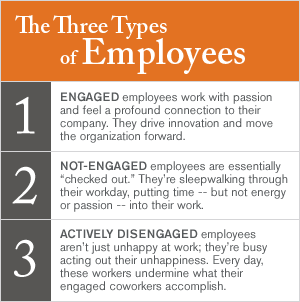
The Three Types of Employees
In 2013, 6% of Chinese people reported being engaged at their jobs and about 26% were actively disengaged.
To put that into perspective, the U.S. workforce is about 30% engaged and about 20% actively disengaged.
China, we have a workplace problem.
 
Command-and-control management doesn't work anymore
If you were to ask me what the most dangerous state of mind in China is right now, I'd say that it's active disengagement in the workplace because it's so widespread. The cause of disengagement in China is the same as it is in every workplace around the world: The workers despise their immediate boss. And the reason they hate their boss is because the wrong person was hired to be the boss. It's that simple.
How does this happen? Well, I know just enough about the Chinese workplace to know that control is of enormous cultural importance. The type of people who are named "boss" in China command and control their "underlings," and those underlings do as they're told. People are not named manager for their ability to engage and develop employees.
But this command-and-control approach doesn't work in the new global workplace, where employees demand more autonomy and want more freedom of thought and action and to be more empowered and engaged. Old top-down management, the type that's entrenched in China, just doesn't work anymore.
 
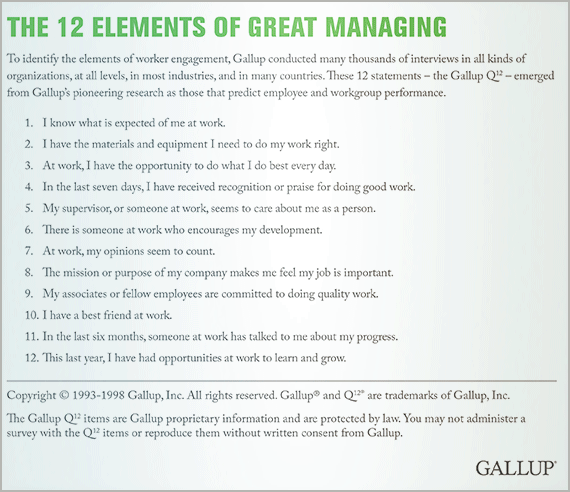
China's national workforce will be transformed -- becoming highly productive and engaged -- when its organizations hire and develop managers who inspire employees to give high scores on these items.
These are the 12 most important, and most predictive, workplace elements Gallup has discovered. China's societal advancement -- or collapse -- lies within these elements, as employee engagement boosts productivity, quality, customer engagement, retention, safety, and profitability.
 
acjudubq8kkpflezh9za7g
 
It would be wise for all Chinese executives and managers to consider how they can deliver on these simple yet transformational demands of the workplace. If Chinese leaders were to change their current spectacularly bad nationwide score of 6% engaged workers to 20% engaged workers, the country would be a completely different place -- one with a much brighter, more stable future.
China must stop choosing the wrong people to manage!
 
Again a voluntaristic (and typically American) call for change, as if  deeply-rooted cultural features could easily be shifted for the sake of good management...