mercredi 16 avril 2014

Chinese company’s military-style teambuilding exercise

In my previous psots I often insisted on the importance of Teambuilding in China.

Teambuilding has to be distinguished with what occurs in many factories, restaurants and business units where blue collars work: Military-Style Drills that are aimed at mobilize the staff. The orders are shouted and strict discipline is required. It usually needs hours of rehearsal and has nothing to do with stress release or Fun.


In China teambuilding can be translated by 团队建设tuandui jianshe however the most common expression in China is “collective activities” 群体活动qunti huodong. The Chinese didn’t wait for American theories about Teamwork to organize Teambuilding

As a matter of fact qunti huodong are an absolute prerequisite to mutual trust that is the very possibility of a cooperation. Since there is no formal trust into the system, the company and its rules, the natural behavior is suspicion, systematic information retention, cold indifference and fierce competition.

I happened to discover this January 2013' video of a team-building exercise recorded in a hotel in northeast China. It has caused an uproar among Chinese Internet users, some of whom say that these methods remind them of those practiced in North Korea: http://observers.france24.com/content/20130118-video-chinese-company-team-building-exercise-youkue-youku
In China, it is not uncommon for companies to organise early-morning pep rallies designed to boost employees’ spirits before they begin their workday. These generally feature songs and chants. However, the unusually rigorous performance by employees at Arirang hotel in Dandong, in northeast China (near its border with North Korea), caused many Chinese Internet users to express their concern on social networks.
In the video, a group of female employees are shown taking part in a sort of drill, repeating slogans praising the company over and over and stamping their feet until they start panting. They also participate in strange exercises, like throwing themselves at a cloth rope, which is supposed to symbolise an obstacle.
The video was filmed on January 8 during the company’s annual employee meeting. It has been viewed over 2 and a half million times on Youku, which is China’s equivalent of YouTube, and has garnered hundreds of comments on Weibo, its equivalent of Twitter.
Contacted by RFI, a hotel employee explained that “this event was meant to strengthen team spirit. All the obstacles, all the difficulties we were faced with this past year, we try to turn them into strengths.”
Here are a few excerpts from the video:
At 28 seconds: “I greet this day with love in my heart. Because that is the secret of success. Muscles cannot pierce shields, nor destroy a life. Only the invisible power of love can open the human heart […] I will use my love as my greatest weapon, and nobody will be able to defend themselves against it. They can counter my arguments, be wary of my words, or disapprove of the way I dress […] but my love will melt all hearts like the rays of sun soften clay.”
At 1’24”: Team leader: “The quickest way to reach success is…”

Employees: “…to follow the right man; to do what needs to be done!”
At 12’40”: Team leader: “To reach our goals in 2013, what do we need to do?”

Employees: “… Stay concentrated on our goals, and never give up! Stay concentrated on our goals, and never give up!”
At 14’24”: “Raise your hands! Put them on your heart! The first bow is for your parents, for their generosity that is deeper than the ocean.”
At 14’48”: “The second bow is for our customers, thanks to whom we feed our families!”
At 15’09”: “The third is for Arirang hotel, which opens the doors to happiness!”

mardi 15 avril 2014

Chinese workers: More than 1000 strikes since mid-2011


Chinese blue collars at IBM Shenzhe factory: "workers are not a commodity", and "Give us back our respect".

More than 1,000 workers walked off the job last week at the factory in Shenzhen, bordering Hong Kong, after managers on March 3 announced the terms of their transfer to new ownership under Chinese PC maker Lenovo Group Ltd. IBM  Shenzhen factory blue collars protest against their American company being sold to Chinese group Lenovo that already control the former IBM PC division.
IBM said last week the terms offered to the workers at the factory in Shenzhen were “comparable in aggregate to what they currently are receiving” and severance packages would be “equitable”. Lenovo has declined to comment.

Last November 2013 Nokia Chinese workers went on strike in Dongguan when they learn their factory was sold to Microsoft. Technology has helped China's workers. When the Nokia factory employees took to the street, they organized through the online chat system QQ and other social media.
 
In the IBM case, the workers had all read about prior strikes, including Nokia's, and suspected ahead of time that they might have to make a similar stand. n both cases - and many others, experts say - the impetus for a strike was underpinned by the fact that the factory branch of the state-backed union was seen as a farce. The state-backed All-China Federation of Trade Unions and its affiliates have a reputation for being ineffectual and often siding with management. The absence of communication channel make labor disputes unavoidable.


Chinese workers are quicker to object if they think their leagl rights are being abused. Accordng to China Labor Bulletin, non-profit Hong Kong-based organization. More than 1000 strikes have been recorded in mailand China since mid-2011. Workers staged protests when they were cheated out of their wages and overtime payments, when their bonuses and benefits were cut back, and when the boss refused to pay the social insurance premiums mandated by law. They also went on strike to demand higher pay, equal pay for equal work and proper employment contract. In 20% of the cases, the police intervened sometimes violently.

Although the Chinese authorities often delete Protests images in social media, they are less prone to censor when the factoy owner is a foreign company. The workers were filmed singing "running dog" when a Chinese manager emerged from the factory to speak, drowning out his words.

During the Cultural Revolution,  "running dog" (走狗 zougou that is to say a lackey, a stooge, a servile follower) was a popular  insult for the Chinese accused of betraying their country by supporting foreign ideas or institutions.

In the IBM case, the "running dog" insult is awkward because the new owner is a Chinese company... Interestingly, IBM blue collers don't seem that happy to belong to national Champion Lenovo, the pride of China.


Chloé Ascencio
source: http://www.nytimes.com/2014/03/07/business/international/chinese-workers-at-ibm-factory-on-strike-amid-company-sale.html?_r=0

lundi 7 avril 2014

culture et internet

En Chine aussi, l’Internet est en effervescence. Loin de copier, les start-up du pays innovent écrivent Florent Courau, Consultant en management, (SJ Conseil) et Dominique Jolly, Professeur à Skema Business School dans Le Monde du 4 avril dernier.
 Fins connaisseurs du marché chinois, les auteurs montrent que certaines entreprises l'internet chinois "ont dépassé le stade de l'imitation" pour proposer "des fonctionnalités absentes des offres occidentales": QQ propose un service d'envoi de dessin instantané bien utile pour des esprits analogiques, ultra pragmatiques et  soucieux de vitesse de réactivité: "dans le contexte chinois, ce service est très puissant". Les auteurs postulent que ce type de service serait culturellement incompatible avec nos cultures cartésiennes et hautement "juridicisées" (valeur contractuelle du dessin?). Autre exemple de créativité chinoise:  les jours de pluie quand les taxis sont pris d'assaut, on peut avec un smartphone faire monter les enchères pour augmenter ses chances d'obtenir une voiture. Là aussi on imagine mal ce type de marchandage imaginable dans la corporation des taxis français! Bien que ces innovations dites incrémentielles ne soient pas des révolutions technologiques, elles nous ouvrent l'imaginaire des possibles. "C'est peut-être notre tour d'aller chercher dans la vitalité chinoise quelques idées pour nous renouveler."

lundi 3 mars 2014

"China, we have a workplace problem" by Gallup

Gallup published a provocative article about China's low workforce engagement one year ago.
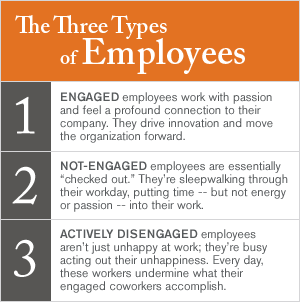
The Three Types of Employees
In 2013, 6% of Chinese people reported being engaged at their jobs and about 26% were actively disengaged.
To put that into perspective, the U.S. workforce is about 30% engaged and about 20% actively disengaged.
China, we have a workplace problem.
 
Command-and-control management doesn't work anymore
If you were to ask me what the most dangerous state of mind in China is right now, I'd say that it's active disengagement in the workplace because it's so widespread. The cause of disengagement in China is the same as it is in every workplace around the world: The workers despise their immediate boss. And the reason they hate their boss is because the wrong person was hired to be the boss. It's that simple.
How does this happen? Well, I know just enough about the Chinese workplace to know that control is of enormous cultural importance. The type of people who are named "boss" in China command and control their "underlings," and those underlings do as they're told. People are not named manager for their ability to engage and develop employees.
But this command-and-control approach doesn't work in the new global workplace, where employees demand more autonomy and want more freedom of thought and action and to be more empowered and engaged. Old top-down management, the type that's entrenched in China, just doesn't work anymore.
 
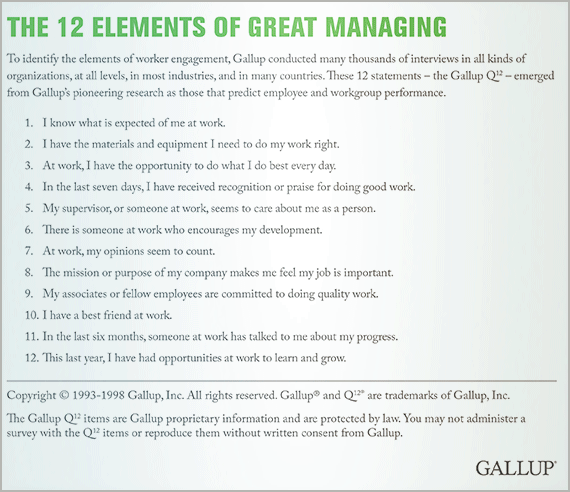
China's national workforce will be transformed -- becoming highly productive and engaged -- when its organizations hire and develop managers who inspire employees to give high scores on these items.
These are the 12 most important, and most predictive, workplace elements Gallup has discovered. China's societal advancement -- or collapse -- lies within these elements, as employee engagement boosts productivity, quality, customer engagement, retention, safety, and profitability.
 
acjudubq8kkpflezh9za7g
 
It would be wise for all Chinese executives and managers to consider how they can deliver on these simple yet transformational demands of the workplace. If Chinese leaders were to change their current spectacularly bad nationwide score of 6% engaged workers to 20% engaged workers, the country would be a completely different place -- one with a much brighter, more stable future.
China must stop choosing the wrong people to manage!
 
Again a voluntaristic (and typically American) call for change, as if  deeply-rooted cultural features could easily be shifted for the sake of good management...

dimanche 2 mars 2014

When Are Chinese Employees More Likely to Speak Up? Is participative management conceivable in Chinese firms?

An interesting field research by the famous Taiwanese sociologist Farh Jiing-Lih's team was led in a sample of 73 local companies in Zhejiang. It found that only 27 percent of the Chinese firms instituted employee participation systems. Approximately 60 percent of the employees reported they did not speak up frequently, and around 28 percent of the employees did not make any suggestions at all.

Voice content can be characterized as being “promotive” or “prohibitive”. Whereas promotive voice expresses new ideas for improvement in the work unit or organization, prohibitive voice expresses concerns about work practices, incidents or employee behaviors that are harmful to the organization.

Speaking up about work issues is viewed as a threat to organizational harmony and a challenge to leaders’ authority. The notion of "face" is not mentioned in this article where psychological terms are prefered. However we could also say that voice is threatening for peers' faces and manager's face.

Because voice is a voluntary and discretionary behavior, it cannot be easily designed into formal job requirements and is largely dependent on employee personal initiatives. 
I do disagree with the former statement: I strongly recommend French firms I provide HR consulting service with to set up "feedback ability" as a very important and rewarded KPI.
Many studies (including mine) have demonstrated that participative management techniques do not work well in China. Even if Western firms' Chinese employees are given opportunities to participate in decision making, they may still choose to withhold their voice and stay silent.
That is whay they should concretely be encouraged to do so.
These findings suggest that voice is highest when multiple psychological motivations – particularly felt obligation and psychological safety – were simultaneously present. That is to say when the relationships (reciprocal trust and exchange of services called guanxi) are good enough to make sure Face won't be lost.

Therefore, managers working in China need to understand the psychological factors (that is to say: the face logic) that either facilitate or prevent employees from speaking up. Our research suggests that managers can create a favorable environment for both promotive and prohibitive forms of employee voice by demonstrating an open attitude toward employees’ ideas and providing favorable interpersonal environment for voice (to enhance psychological safety), reminding employees that they are valued membersof the organization and capable of valuable input (to increase organization-based self-esteem), and caring their employees and emphasizing that employees can give back to the organization by making suggestions and pointing out ineffective processes (to increase felt obligations). 
This is exactly what we advocate during our "Managing a Chinese Team" trainings where leaders experience how they can adapt their management style to the Chinese employees' values and expectations.

However the challenge is huge for Chinese managers who usually are not convinced about the benefits of participative practices. Even if the article's authors advise them to change: Chinese managers need to be very cautious about their authoritarian behaviors if they hope to receive intellectual inputs from their employees, it might not be sufficient to make them put their education, beliefs into question. How useless are voluntaristic injunctions found in standard leadership trainings: just do it! They can be intellectually convinced. However in daily operations, what is bred in the bone comes out in the flesh: topdown management practices are merely encouraged and confirmed by Chinese authoritarian environment. Ask any Chinese manager about staff's participation to decisions-making: he/she will tell you "this is good in the West, but not in China." 
According my experience, only the Chinese managers who got deeply accultured during a lifetime and real management experience in the West can change their mindset and style, provided they get some coaching support to be able to analyze their change process.


 http://www.iacmr.org/v2en/CMI/Vol3Issue1/eCMI_7.pdf Abstract based on the full article, “Psychological Antecedents of Promotive and Prohibitive Voice: A Two-Wave Examination,” Academy of Management Journal, Vol. 55, 2012.

mercredi 19 février 2014

Chinese employees' Level of Engagement is still very Low

A 2013 survey by Gallup[1] revealed quite negative results about Employees’Engagement at work in China. Actually this country has one of the lowest engagement rate in the world:
Engaged: 6% in 2012, up from 2% in 2009.
Not engaged: 68%
Actively disengaged: 26%

Across social categories, the results are different as usual since education level and job interest play an important role in engagement:

Blue collars :
Engaged: 6%
Not engaged: 67%
Actively disengaged: 26%

Sales & Service workers:
Engaged: 4%
Not engaged: 69%
Actively disengaged: 27%


Professional workers and managers/executives/officials:
Engaged: 8%
Not engaged: 71%
Actively disengaged: 20%

 Despite the improvement, engagement in China is still low compared with the global average of 11% that Gallup measured in 2009.
 For Gallup the reason is clear: “Chinese Employees Don’t Feel They Have a Voice at Work”. Since “Chinese workplaces are often characterized by “commandand-control” hierarchical structures, and in many cases, people are not selected as managers for their ability to engage and develop employees. This practice is particularly troubling as Gallup’s research shows that managers have a critical impact on their employees’ engagement levels.
Gallup’s 2012 surveys reveal that 57% of Chinese workers say their job is ideal for them — among the lowest figures in East and Southeast Asia.
Most Chinese employees believe that their efforts are insufficiently recognized and rewarded. Gallup compared these results with a similar survey conducted 15 years ago, and observed Chinese blue collars have became more individualistic, seeking to fulfill their personal ambitions.
However they are disappointed by local companies offering few opportunities to learn and grow. The prevailing sentiment seems to be frustration: "I am not important nor for my manager nor for my company."
The cause has been identified : authoritarian management style and favoritism do not value individuals - and cannot meet young generation’s expectations anymore.

Consideration for Human Resources in Chinese companies is a brand new phenomenon. It is obviously driven by talent shortage: worker is still an “object” exploited at will. There are usually despised by top managers, as this remark from a Chinese store manager to his European colleague: Why do you greet this woman? She is the office maid!”
Reversely white collar has become a valuable person of value deserving to be taken care of, motivated and retained… So HR Departments now take their needs and expectations into consideration. To understand RH management in China, it is essential to distinguish between educated Chinese employees and low-educated workers. We can even dare to draw a parallel Confucius’distinction between “little people” 小人 xiaoren and gentlemen 君子 junzi. In China, behavior, communication and management style mostly depend on who you are.


mardi 18 février 2014

French meetings and reports - How Chinese can fit in?

Continuons notre commentaire de lecture sur le livre "French management, elitism in action". Il nous offre un miroir intéressant, notamment pour mieux comprendre comment les Chinois vivent leur intégration dans un groupe français.

"Formal meeting are often prefered to informal 'Management by walking',  this American interactive and unstructured approach, which is perceived as "flicage". French preference for meetings is understandable in that these are occasions for planning and reflection (intellectual effort) and bring conflicts to a head. As an expatriate foreign manager complained: In this country, they love intellectual debate, discusions and calling into question, even if it means equivocating and pushing back the actual moment of decision."
"Organizational status can be enhanced by skilful advocacy and stylish expression or lost through poor eloquence and reasoning."

C'est une réalité implacable pour les Chinois car ils manquent souvent d'éloquence en réunion, et cela les dessert beaucoup. Leur réserve est parfois assimilée à un manque de capacité d'analyse ou de résolution de problèmes. Peut-on imaginer en France un professionnel pourvu d'une intelligence critique mais qui ne s'en servirait pas en réunion? Un leader qui aurait du leadership mais ne le montrerait pas publiquement? Cacher son talent est un spécialité chinoise: par éducation, par respect (démesuré en contexte occidental, mais  obligatoire en Chine) de l'autorité, pour protéger la face des uns et des autres...
C'est pourquoi je coache des managers chinois à un mode de communication plus direct (éviter les allusions) et plus assertive (oser dire non, et si on est d'accord, dire pourquoi pour montrer son intelligence). Garder le silence en réunion est assimilé en France à une forme de passivité nuisible à l'image.
 
"While managers from US and Britain place high value on compromise, the French tend to interpret the word negatively. By French reasoning, why go for a second-rate or improvized solution if the perfect solution is vailable either through clever synthesis or by achieving consensus on which is the better idea? Persuasion in France  is about beating the opposition into intellectual submission And that can take time."

Participer au débat plutôt que se mettre en retrait est le premier objectif sur lequel je fais travailler les cadres chinois. Le second est d'animer une réunion avec des collaborateurs français. Grand challenge pour un manager chinois peu habitué à être challengé par ses n-1, qui plus est en meeting: c'est la cause la plus classique de perte de face. J'explique aux managers chinois qu'être consultés est essentiel pour que les Français se sentent respectés, et donc ne sabotent pas les décisions prises par le patron. Ainsi la perte de face est compensée par un gain:  la possibilité pour le manager de prendre in fine sa décision.

"Internal reports play a greater role than in Anglo countries which rely more on oral présentations and discussions for disseminating information.  French cadre will spend time reading and commenting on reports which have been circulated. They will also spend time preparing such reports for others to read Conceptual consistency and style is more important than practical feasibility. So it requires mental preparation and intellectual work to argumenting with French colleagues."

Ces remarques sont valables pour les Chinois, adaptes de l'informel, qui sont réticents à rédiger des rapports surtout s'il s'agit d'analyse des risques (je vais me faire des ennemis), des plannings ou des forecasts (le futur étant imprévisible, je vais perdre la face), leur vision pour la marque (mais qu'est-ce que le patron attend de moi?).
Néanmoins, ces aptitudes se travaillent et grâce à l'accompagnement personnalisé de ces managers chinois souvent capables d'une grande flexibilité, le changement est possible!